

Introduction
One of the greatest risks for businesses when employing people is getting payroll compliance wrong. Public policy has shifted significantly over the past three years, focusing in heavily on employee entitlements and underpayments, resulting in an increase in regulator activity, available penalties and the possibility of criminal charges in serious cases.
What are Awards and why are they important to understand?
Awards are legal documents published by the Fair Work Commission that set the additional minimum entitlements on things such as higher minimum wages, overtime rules, penalty rates, monetary allowances, consultation requirements and many other rights. These apply in addition to National Employment Standards outlined in the Fair Work Act 2009 (Cth).
Too often, businesses do not use the appropriate Award to set the minimum conditions for their workforce. In some cases, they apply the wrong Award because they prefer a different Award, or they think that because they pay above minimum wage, there is no requirement to follow the rules in an Award. This can have significant compliance consequences for businesses.
One of the key principles of award compliance is that employers and employees don't get to pick the award that they want. Awards will apply to that employment relationship automatically as a matter of law setting those minimum entitlements.
Although most Awards appear to be similar to each other, they can vary significantly on matters such as ordinary hours, minimum wages, penalty rates and leave entitlements. Getting this right the first time can help save employers a lot of headaches.
How does Award coverage work?
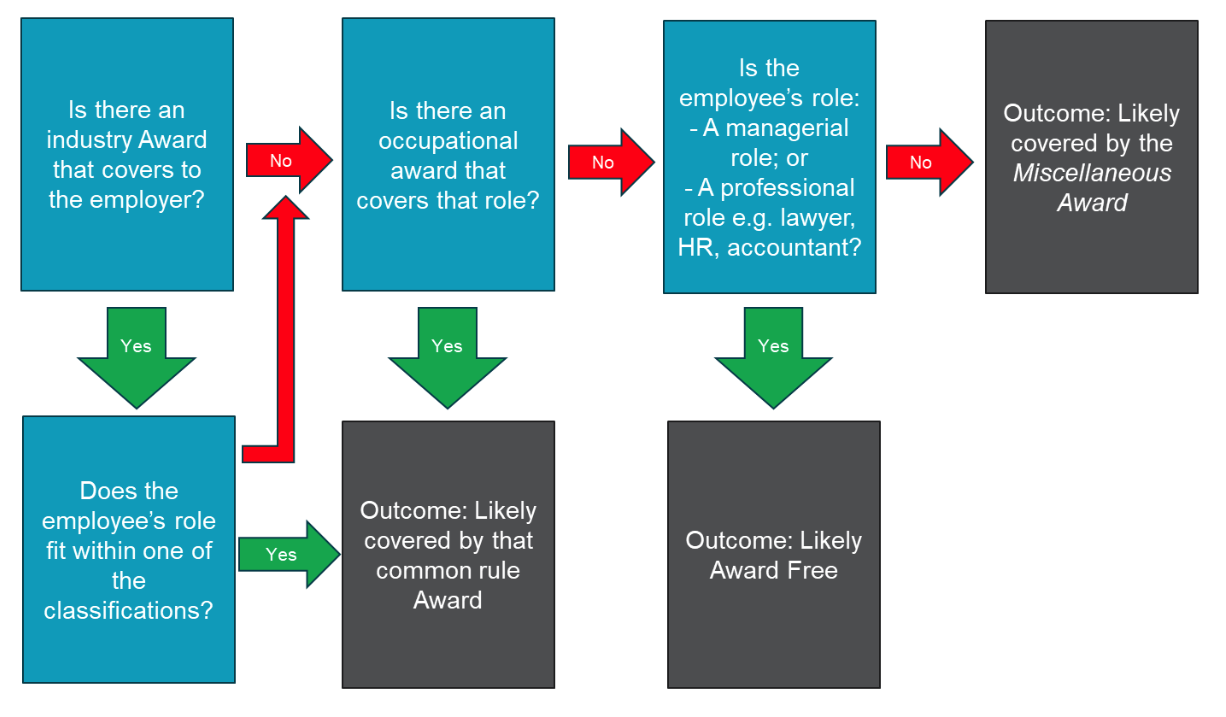
Since 2010, there are around 122 “common rule” awards in Australia that can be applicable depending on the nature of the employer’s business, and the role that an employee performs. All Awards will have a written coverage clause that will describe the types of employers and employees that could be covered by the conditions of those Awards. A coverage clause will outline that it covers employers and employees based off one (or both) of these criteria:
- Industry Awards, which will cover employers in a particular industry and the employee roles covered in the classification.
- Occupational Awards, which cover certain roles and professions regardless of the employer’s industry.
Where neither an industry or occupational award covers the employee, they could still be covered by the Miscellaneous Award 2020, which is intended to capture roles that were traditionally covered by Awards before 2010 that are no longer covered due to the drafting of modern award coverage clauses through award modernisation. If that Award does not apply, the employee is likely to be Award free. This flow chart can help to navigate how to determine the appropriate award:
Challenges in determining the appropriate Award
Determining coverage can be sometimes straightforward. However, this exercise can be more challenging where a business works across different traditional industries and where a business, is in a niche or emerging sector.
In many cases, there are multiple Awards that could arguably be considered to cover the employment, or it is unsure whether the employee is Award free. Although multiple Awards can be described to cover an employment relationship, only one can “apply” and actually set those minimum entitlements.
How do you select the right one in these kinds of situations? In some cases, the coverage clauses will specify that one award will prevail over another. Where this isn’t clear, Courts and Tribunals will apply the principal purpose test, which considers the actual purpose of the role to determine which Award, if any, applies.
How can Skildare help?
Skildare has experience across a wide range of industries and sectors, which equips us with a solid understanding of the most used awards and where they become applicable. The world of Award compliance is complex. Our mission is to make HR simple to give you peace of mind that you are meeting your compliance requirements.

Recent Articles



Article written by:
Related Case Studies



Keep up to date with HR changes that matter
Subscribe to the Skildare Newsletter for practical advice, legislative updates, and insights to help you make informed decisions for your business.

.png)